Showing posts with label Academic. Show all posts

Tuesday, 14 May 2013

CORDUROY - Rarities Box-Set


It is between the notes (between the sharps and the flats) that’s where you’ll find the jazz, the good stuff; everything else is just playing scales. Similarly, it’s between the lines of our story (between the myth and the cliché) where you’ll find the source; the musical gold.
      Much has been written about Corduroy, a history of the band spread like Wikipedia whispers through recycled sleeve-notes and the re-ordering of the same tracks over relentless ‘best-of’ compilation albums. This box-set gives fresh perspective, featuring recordings that preceded the group’s fabled deal with Acid Jazz Records, other tracks recorded at the bitter end of the partnership, and some that were simply forgotten; plus the holy grail of all audio treasures - an unreleased single.

Corduroy formed on the periphery of the beat scene, at the tail end of 1991, within a few months, after a brief meeting with Edward Piller in 92, they signed a deal with his label and in the studio the following week. Three albums were released by London’s Acid Jazz Records:

      Dad Man Cat - Raw Hammond funk with fast bass runs, funky drums and punky guitar, the template of the Corduroy sound. The title blended from three jazz words used by the sixties Rat Pack and combined as one - bop-talk.  

     High Havoc  - The soundtrack to a mythical movie; a spy film featuring the grooviest clubs, evil fez wearing villains and the longest limbed girls in the whole of swinging London. The title, a potent mix of ‘high camp’ and unbridled chaos, epitomising the band’s famed live energy, with added conceptual orchestration.

     Out Of Here  - A tamer, vocally led record with nods towards American AOR bands of the seventies; a more traditional ‘Acid Jazz’ sound that ironically led the group to contrive the title to become the band’s farewell. 

Cherry Red Records, with the assistance of the band themselves, have compiled within this box the three albums (including period single B-sides) plus a fourth bonus live album. You may already have one or all of them; chances are you’ve at least heard some of the songs. You will not however have heard the rarities included throughout; sourced directly from band member’s personal archives, they contain the untold story, the bits that have been missed - the lost pieces of the final musical jig-saw puzzle.

Having been previously dropped by Sire Records, proto-Brit-poppers Boys Wonder, led by the Addison twins (Ben and Scott) recruited Richard Searle (the Doctor & the Medics and occasional Boys Wonder bassist) for a one off new years-eve show at Up The Creek in Deptford, South East London, in 1991. The style, heavily borrow from a guitarist friend, Simon Nelson-Smith's own band, largely consisted of jazzy instrumental cover-versions. With Simon established on guitar, the gig was a success and the four-piece started to write and demo more material in the front room of Ben and Scott’s family home in Blackheath. Not only was this a cheap way to rehearse, but the room had great acoustics. To that end, a porta-studio cassette demo was recorded, E-Type (from which a budget video was shot).
      It is from these formative ‘living room’ sessions that the majority of the debut album was written. Recorded in Denmark Street’s Bass Head Studio, some tracks (due to lack of time) were shelved and forgotten. Goober Grape (inspired by a jar of peanut butter and jelly marshmallow whip). Sesame Street (the TV theme - an early inclusion in the very first live set). Funky Freedom (a jam based on a Boys Wonder track). Happy Shopper (a thrash swing number) and a Quincy Jones tune - Hikky Burr. Thought lost, they are included here, mistakes and all.

The follow-up album High Havoc (also recorded in 92) was released and toured in 1993; two singles Something in My Eye (originally a demo on which Ed Piller invited Ben & Scott to collaborate) and The Frighteners, were taken from the album. Another popular live track, Very Yeah, was re-arranged whilst on tour, with vocals (not featured on the album version). In late 1993, it was agreed to edit the album recording, add the vocal part, and release the radio friendly Very Yeah (vocal version) as a third single. However, Acid Jazz was approached by Channel 4’s anarchic television show, The Word, with the opportunity to feature Corduroy live on the program - on the condition that they played a track from their encore (a cover version of Lemmy Kilminster’s speed metal signature tune) Motorhead by Motorhead. The track was reworked, recorded and released as the next single - instead of the Very Yeah edit.
       It transpired that The Word would only show one Acid Jazz band; label mates, Mother Earth (published and managed by Acid Jazz) appeared on the program in Corduroy’s stead. The Very Yeah (Sing Song Sing-Along) was shelved, forgotten and thought lost; it is included here.

Motorhead featured on the third album Out Of Here (recorded in Peter Gabriel’s Real World Studio in Bath) released in 1994, the track Mini was chosen as second single. The prize of an actual Mini-Cooper, with custom Corduroy paint job, was raffled on stage as the highlight to the promotional tour. It still appears at occasional car shows. 

Much of 1994-95 was spent on the road. Gigging throughout Europe, Singapore, Hong Kong, Australia, Japan and the UK, plus a coveted support slot with Camden- lovies- Blur (at Alexandra Palace) alongside Pulp and Supergrass; this was arguably Corduroy’s most popular moment. However, ambition and altercation saw a split with Acid Jazz Records which resulted in Corduroy signing to a subsidiary of Richard Branson’s newly formed V2 record label, Big Cat.
     There were however a handful of recordings for Acid Jazz, that although scheduled as singles, were not formally released at the time. Summer In My Eye (a harder Latin remix of Something In My Eye) and Clockwork Man. Both (including B-sides) have since featured on various, ‘bonus-edition’ releases and ‘best-of’ compilations (to date there have been at least six). However, the band was not happy with the recording of Clockwork Man and re-recorded the song in a heavier style in 1995 (at Eden Studios in London); with the group’s soundman, Ricky Rickets, behind the mixing desk. This new faster version of the song was far more successful, but only featured on one rare Japanese compilation; thought lost, it’s included here.

The fourth album The New You, (recorded in Roundhouse studio, London) in 1995, was released in 96. A vocal heavy, song based album this time, the psychedelically exotic The Joker Is Wild chosen as single.

The fifth and final studio album, recorded throughout 98, Clik was also released by Big Cat in 99. This album, which took a torturous six months to complete, had a more sequenced flavour, drum n’ bass producer Rob Playford at the controls in his own studio. Moshi Moshi  to be the first single from this album.

Many bands have a ‘moment’, a chance to break free from the lower reaches of the record charts; Corduroy never managed this transition. Despite their popularity live, and a fanatical fan base, the group received little radio play and remained an underground act. Things may have been different if they had appeared on The Word, or remained true to their early musical root - the funny filmic funketeers who shared vision and goals. Perhaps they shouldn’t have switched labels. By 1999 tensions and deceits within the band were at a head and moral at an all time low. Moshi Moshi  failed to chart. Big Cat released a second single from Clik, a contrived disco track, Thing For Your Love; the death rattle of a band without direction. Corduroy were dropped by Big Cat Records, Big Cat were dropped by V2. The band split in late 1999. 

The bulk of this collection dates from the Acid Jazz years; however miscellaneous studio recording (post Acid Jazz) resulted in several tracks that were never released. The old-school jazz instrumental Get Ron Carter, a kitsch psych-epic about fractals The Mandelbrot Set, and a protest song that harks back to the glory days of the Acid Jazz years, Man Alive. 

The band’s limping cassette porta-studio was upgraded to a digital hard drive version; experimentation with this new machine resulted in prolific demo recording, Apple Pipe,  Preacher, Another Hundred Years, Finally Atlanta, The Impossible Smile, and the brooding Original Sin. These bonus tracks, thought lost, are also included here.

It is within the musical DNA of the bonus tracks (those featured for the very first time), a spark of brilliance that defines the essence of the true Corduroy sound; a passion and joy for a genre played with an infectious enthusiasm (particularly apparent in the ‘living room’ sessions); a band simply playing for fun. Likewise, the fourth bonus disc, The Quattro (Live In Japan 1994) CD, is a rare live document that commands three figures from certain on-line retailers. Recorded in one of the bands favourite venues, on one of Corduroy’s six Japanese tours; this was the live set (evoking fast cars, fast girls and sharp threads) that helped elevate ‘the fabric four’ to cult status; to be emulated by contemporaries, to pre-empt the verve and life-style since championed by Austin Powers, to be chased through the streets of Shibuya by the prettiest girls with the longest legs in Tokyo; a groovy swinging soundtrack to an imaginary cartoon-world of sheer unadulterated silliness.  Very Yeah!   


  Searle Richard (2013) Corduroy.Very Yeah-The Directors Cut, Complete Compositions 1992-95.

  Searle Richard (2011) Corduroy. Mod Speed Blog.
                                                                                                  

Thursday, 23 August 2012

The seaside - codes, behaviour and class.


‘I’ve got to move with the fashions or be outcast’ (Pete Townsend. Cut My Hair. (1973)). To follow the changing modes and manners, to run with the expectations of one’s culture and the crowd, the seaside and its ceremony has, especially for the lower-middle and working-classes, remained part of and a place for a little relief and respite from the stresses and smoke of an urban lifestyle, a break from the drudgery of the everyday. This essay shall examine the history and rationale surrounding some of the strict codes of behaviour that, in my opinion, help to make the seaside part of this ritual of escape. 

Along with measured therapeutic doses of seaside bathing, the consumption of sea water was popular and considered beneficial to one’s health by the upper-classes of the 1730s, advice that medical practitioners evolved from a similar well-established tradition involving mineral springs. Believed to be dangerous without the correct supervision of skilled staff, called Dippers, from modesty preserving beachfront covered wagons, called Bathing Machines, the cold water shock to the skin, nerves and internal organs was carefully regulated and costly, the reserve of the high-society set, the sickly well-to-do. ‘Bathing was not supposed to be pleasant’ (Deborah Brunton (2008) pg, 170). Taking the health-giving sea air was an agreeable alternative to icy bathing, although a claim that was scientifically dubious, ‘chemical analyses (exaggerated results which) showed that air samples [...] contained [...] (high levels of) ozone’ (Deborah Brunton (2008) pg, 171).

Breathing the sea breeze was far simpler than enduring chilly salt-water submersions and much cheaper for the less wealthy middle-classes, who could of course swim a little as well if they so wished, separated a suitable distance from the price prohibitive Bathing Machines. Despite the embellishment of the medicinal benefits, albeit providing a real escape from city smog, the seaside visit, by the later part of the eighteenth century was a ‘very fashionable activity’ (Deborah Brunton (2008) pg, 170).

As the Victorian middle-classes flocked to the seaside to enjoy the air, resort towns cashed in providing promenades, parks, winter gardens and piers, the better to enjoy the experience. ‘By the end of the nineteenth century, every seaside resort town of any size had a pier,’ (Deborah Brunton (2008) pg, 173), some carrying an entry charge, an attempt to ‘maintain a select tone for the well-off, high-class market’ (Deborah Brunton (2008) pg, 109). Middle-class holidaymakers were quickly joined by the lucrative ‘day tripping’ working-classes; the seaside escape was soon established, across the entire social spectrum, both in and out of the water.  


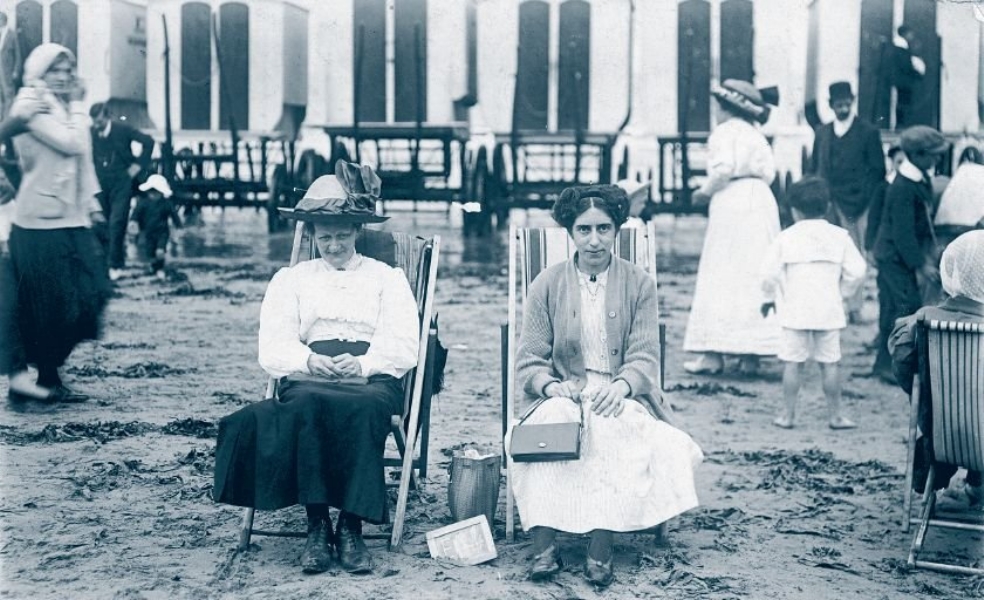
‘Zoot suit, white jacket with side vents five inches long’ (Pete Townsend. Cut My Hair. (1973)). Whilst exploiting the welcome refuge from the urban routine that seaside trips awarded its visitors, the different cliques and classes still elected to bring along their own familiar fashions, tastes and traits, which helped define stereotypical behaviour. ‘The seaside was a place which had its own expectations of behaviour, reflected by a kind of uniform’ (Lucy Faire, (2008) pg, 136).  The health-conscious Victorian upper-classes, formally dressed, ladies in long skirts or dresses and large brimmed hats, shaded from the sun, ‘tanned skin was associated with those who worked outside’ (Lucy Faire, (2008) pg, 134). The holidaymaking middle-classes, respectably dressed, relaxing with their shoes on, ‘bare feet [...] (was) a sign of poverty’ (Lucy Faire, (2008) pg, 135). The ‘rowdy’ working-classes arrived on mass suited and booted in their Sunday best, ‘the suit was worn in leisure time. It didn’t have the negative work-related connotations it has today’ (Lucy Faire, (2008) pg, 135). Too proud to wear work clothes, they couldn’t afford holiday clothes as well. Bare legs were not shown, ‘no adults wore shorts, at least not until the early Thirties’ (Goldman, (1997) pg, 71).

The inter-war years saw a less formal dress code, more casual, more flesh exposed. Financially liberating, this was a ‘new democracy of dress, [...] the working-class could now afford Sunday and holiday clothes’ (Walton, (2004) pg, 160). Skirt hems were shorter, as were shirt sleeves. ‘This reflects the growing general acceptability of displaying arms and calves; being tanned was now a reflection of health’ (Lucy Faire, (2008) pg, 135). Floral silks and sandals were in vogue for the ladies and Oxford bags trousers with bow ties and brogue shoes for the men, brash, flashy and fun. Fashion trends continued to change throughout to the post-war years ‘and the kinds of clothing generally associated with the beach today were adopted’ (Lucy, Faire, (2008) pg, 137). 


The fickle detailing of youth culture brought its own in-styles and dress codes. When the guitarist and songwriter from the rock band The Who, Pete Townsend, in his ‘Prog’-concept album, about a seaside obsessed teenager entitled Quadrophenia, ‘incorrectly’ described the slim fitting suit favoured by Mods in the sixties as a ‘Zoot’ suit, which was in fact an early 1940s baggy suit, he was expressing the importance of fashion codes. Looking good was all important, and being seen looking good required a suitable location to be noticed. 

‘Dressed right, for a beach fight’ (Pete Townsend. Cut My Hair. (1973)). As well as leisurely strolls along the promenades and piers ‘the jetty, was for those who desired to exhibit their wardrobes’ (Walton, (1983) pg, 209), a good place to show off. Another was music-halls. Music was popular from the Victorian era onwards and seaside music venues were a perfect place for the seaside tribes to congregate. The wealthy-set frequenting discrete hotel palm rooms and sedate assembly-halls for breezy performances by dignified string ensembles. Attempts were made to segregate the social divisions in some venues. ‘Blackpool’s North Pier [...] was a select venue where orchestral concerts were held with a charge for admission to discourage undesirables’ (Trevor Herbert, (2008) pg, 112). 

The lower-classes, by necessity, preferred to congregate around cheap music-halls or public bandstands, where amateur brass bands attracted large audiences with loud rousing tunes. The ‘vulgar’ east coast music-halls brimmed with London working-class folk and traditional working-class behaviour, which received disapproving commentary in the broadsheets. A commentator in The Times noted ‘a Seven-Dials-on-Sea, a perpetual Derby Day [...] a saturnalia of lounging and drunken and card playing humanity’ (The Times (1885) pg, 4).

 As a ploy to encourage the sobriety of the ‘plebeian public’ (Walton, 1998, p. 39), the upper-classes prescribed ‘rational recreation’, the pursuit of morally sound and self-improving activities, such as exposure to ‘high-brow’ music. With this in mind, contests between travelling brass bands performing classical pieces were organised, to focus attentions on friendly competition. The railways happy to provide sponsorship and affordable tickets for travellers in support of their local band, ‘there is persuasive evidence to show that the phenomenon of the cheap day excursion [...] was invented specifically to attract audiences to these contests’ (Trevor Herbert, (2008) pg, 115). The lower-middle and working-classes flocked to these ‘battle of the bands’ events, bringing with them their hard earned money and hard won habits. ‘It should be said that the virtue of these events was sometimes marred by the fist fights that broke out among rival supporters when a controversial result was announced’ (Trevor Herbert, (2008) pg, 115).

The image of the working-classes, fighting, smartly dressed in their best suits or smartest clothes was one that was repeated eight decades later, ‘as with many things in life, traditional habits die hard’(Lucy Faire, (2008) pg, 137). The 1960s witnessed bank holiday beach fights between rival gangs of Mods and Rockers, opposing working-class youths with very different codes of fashion and behaviour. The Rocker’s philosophy of ‘bikes, booze and birds’ (Cafe Racer, (2005)), leather clad with oily Brill-creem quiffs, at odds with the clean-cut Mod pill-popping ‘peacockery,’ who’s neat Italian hairstyles and bespoke suits were proudly worn like battle dress.

The Rockers typically frequenting pubs and cafes, listening to 50s Rock n’ Roll on jukeboxes, British motorcycles parked outside. The scooter riding Mods packing out the dance-halls, amphetamine fuelled and dancing to the latest imported U.S soul records, the music as important to the lifestyle as the clothes ‘they took their name from the sound of Modern Jazz’ (Edward Piller, (2008)). This was an echo from the Victorian era of dance-halls as a preferred venue for the working-classes to congregate and let off steam.


‘I am man who drives a local bus’ (Pete Townsend, The Dirty Jobs, (1973)). The Mods were typically working or lower-middle class kids. Hand tailored suits were expensive; the correct cut was essential to look sharp, to look ‘book’. ‘Mod living is an aphorism for clean living under difficult circumstances’ (Pete Meaden, N.M.E (1775)). Mods, like the lower-class holiday makers of decades past, worked hard to look good, to follow trends, to be a ‘face,’ ‘the right clothes mattered, they showed you were in’ (Anne Allen, The Daily Sketch (1958)). The culture of ‘living for the weekend’, the two days in the week when the working-classes stopped ‘grafting’ and ‘let their hair down’ was life affirming, work hard play hard. ‘The seaside resort offers a break from the routine of work and from the social controls of family, community and workplace’ (BFI, Holiday Escapes (2010)). Traditional brash behaviour, drinking, partying and fighting, that when taken to the seaside, taken on holiday, became even brasher. The escape from the routine of work was amplified, accepted within the cultural group because ‘they were on holiday’, at the seaside, ‘the playground of the workers’ (Partridge (2001)), and dressed to impress.


‘A beach is a place where a man can feel - he’s the only soul in the world that’s real’ (Pete Townsend, Bell Boy, (1973)). As the seaside ‘rucks’ between Mods and Rockers, roared on by tabloid journalism, became established, Mayday bank holiday scooter runs became part of the ‘ritual’ in the Mod fixture, a calendar event for later 1970s modernists to copy and emulate with fanatical fervour. ‘The sacredness or special nature of a place may be connected with the presence of a particular [...] significant event or with something about the location’ (Harvey and Bowman, (2008) pg, 60).     
                                                                                                      
From one event, the Margate disturbances of 1964 - ‘Mods verses Rockers’, the seaside, for these young working-class youths, became a ‘sacred’ place; a seaside trip was a ‘pilgrimage’. ‘Places inherently express [...] social divisions’ [...] they are [...] spaces (with) certain meanings, association [...] and emotional geography’ (Morgan Nigel and Pritchard Annette, (1999) pg, 6). With the higher-classes now preferring to holiday abroad and an apparent acceptance to ‘over-look’ low-brow activities, the working-classes had claimed the seaside as their own. ‘Once the symbol of high culture [...] the British seaside lost its high social tone in the twentieth century as it’s wealthier visitors responded to the influx of working-class visitors by seeking more exclusive leisure sites elsewhere’ (Morgan Nigel and Pritchard Annette, (1999) Pg 6).                                                                      
 
The ancient Greek philosopher, Epicurus, described leisure time as ‘a means to pleasure - a sanctuary from the hassles and hazards of public life’ (Jon Pike (2008) pg, 19). The weekend provided the opportunity for this sanctuary, a release for the working man. The seaside became a focus for this release, a place where they could get away with stereotypically boisterous behaviour. ‘The resort is a separate space, where a special licence exists to break down the usual conventions with boisterous behaviour, indulgence, late nights and sexual liaisons’ (BFI, Holiday Escapes (2010)). My conclusion to this essay is that the seaside has always been ‘a place of escape’ - and -‘has always been a place with its own strict codes of behaviour’, I disagree that escapism and coded conduct cannot co-exist; my argument is that they have developed together simultaneously, hand-in-hand.  

The journey that the seaside has made, throughout its history, has seen what was once a health resort for the upper-classes transformed into a playground for the working-classes, who ultimately cracked the code to  best exploit escapism - ‘the primary point of a holiday [...] is to enjoy yourself, for tomorrow you must work’ (Morgan and Pritchard, (1999) pg, 20).
                                                                                                                   
Richard Searle (May 2012)
                                                                 
.........................................................................................................................................
Bibliography

Allen Anne. Are you a Trad or a Mod? The Daily Sketch. U.K (1958)

BFI. Resources for teachers and students. Holiday escapes. U.K (2010)

http://www.bfi.org.uk/education/teaching/hindlewakes/teaching/holiday.html

Brunton Deborah. The Healthy Seaside. AA100 The Arts Past And Present. Places and Leisure. The Open University. Milton Keynes. (2008).

Goldman, L. Oh What a Lovely Shore: Brighton in the Twenties through the Eyes of a Schoolboy, Brighton, The Author. (1997) quoted by Lucy Faire. Dressing For The Beach. AA100 The Arts Past And Present. Places and Leisure. The Open University. Milton Keynes. (2008).
Harvey Graham and Bowman Marion. Sacred Space and Landscape , AA100 The Arts Past And Present. Places and Leisure. The Open University. Milton Keynes. (2008).

Lucy Faire. Dressing For The Beach. AA100 The Arts Past And Present. Places and Leisure. The Open University. Milton Keynes. (2008).

Meaden Pete. Interview with Steve Turner. The NME. U.K (1975)
Morgan Nigel and Pritchard Annette. Power and Politics at the Seaside. University of Exeter Press. U.K (1999)

Partridge Andy. Bungalow. An XTC Resource. (2001) http://www.mysipod.co.uk/bungalow/dict/glossary/bungalow.htm

Pike Jon. Leisure And The Purpose Of Life.  AA100 The Arts Past And Present. Places and Leisure. The Open University. Milton Keynes. (2008).

Piller Edward. Mods. BBC Radio 4. (2008).

Townsend Pete. Bell Boy. Quadrophenia. Track Records. (LP) UK (1973).
Townsend Pete. Cut My Hair. Quadrophenia. Track Records. (LP) UK (1973). 
Townsend Pete. The Dirty Jobs. Quadrophenia. Track Records. (LP) UK (1973).                     

The Times, 16 September (1885) quoted by Trevor Herbert. Victorian Seaside Music. AA100 The Arts Past And Present. Places and Leisure. The Open University. Milton Keynes. (2008).

Trevor Herbert. Victorian Seaside Music. AA100 The Arts Past And Present. Places and Leisure. The Open University. Milton Keynes. (2008).

Stazz. Cafe Racer. net. Forum thread (2005).

Walton, J.K. ‘The seaside and the holiday crowd’ in Toulmin, V, Russell, P. and Topple, S. The Lost World of Mitchell and Kenyon: Edwardian Britain on Film, London, British Film Institute, (2004) quoted by Lucy Faire. Dressing For The Beach, AA100 The Arts Past And Present. Places and Leisure. The Open University. Milton Keynes. (2008).  

Walton, J.K. Blackpool, Edinburgh, Edinburgh University Press, (1998) quoted by Colin Chant. Technology And The Seaside: Blackpool And Benidorm.AA100 The Arts Past And Present. Places and Leisure. The Open University. Milton Keynes. (2008)